The Science of Laser Tattoo Removal
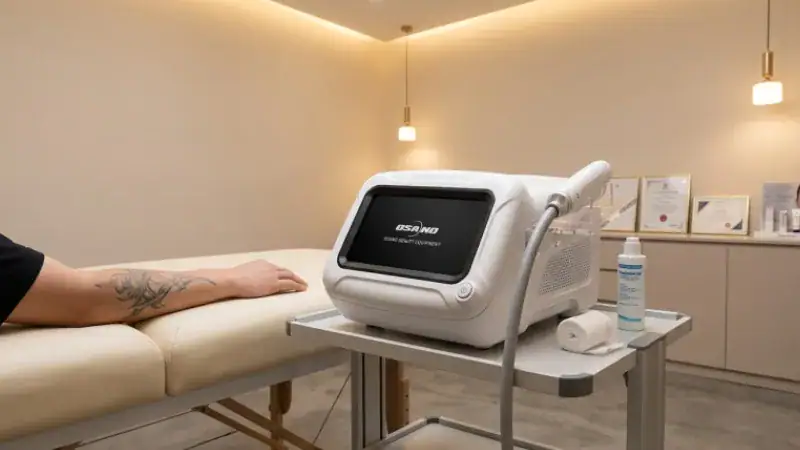
All professional tattoo removal lasers operate on a fundamental and safe scientific principle called selective photothermolysis. Using ultra-short pulse durations, this laser technology ensures that the treatment specifically targets the pigment without harming the surrounding skin tissue.
The tattoo laser acts like a highly precise hammer that only hits the tattoo ink, ignoring the normal skin. It shatters large, permanent ink into tiny particles or microscopic dust, which your body’s natural immune system then safely flushes away over a few weeks, minimizing damage to surrounding skin.
Q-Switched vs. Picosecond: Best Tattoo Removal Laser Devices
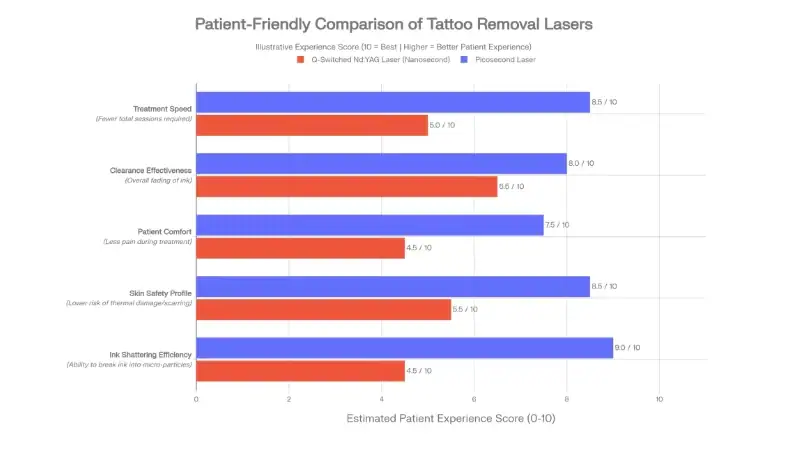
In the modern aesthetic industry, there are two primary categories of laser tattoo removal devices used for commercial applications: Q-Switched Nd:YAG nanosecond lasers and Picosecond lasers. Understanding the difference between picosecond and nanosecond technology is vital for building your clinic’s service menu.
|
Feature
|
Q-Switched (Nanosecond) Laser
(The Cost-Effective Workhorse) |
Picosecond Laser
(The Premium Flagship Device) |
|---|---|---|
|
How It Works (Simply)
|
Acts like a “hammer.” Uses high heat to crack and break the tattoo pigment apart.
|
Acts like an “acoustic shockwave.” Extremely fast, pulverizing pigment using mechanical pressure instead of heat.
|
|
Ink Shattering Effect
|
Breaks ink into “pebble-sized” fragments.
(Takes the body longer to metabolize). |
Pulverizes ink into “microscopic dust”.
(Easily and quickly flushed out by the immune system). |
|
Sessions Required
|
Approx. 6 – 12 Sessions
(Longer overall treatment cycle). |
As few as 3 – 5 Sessions
(Extremely fast results, saving months of time). |
|
Best For Which Colors?
|
Basic Colors: Black, grey, dark blue, red.
(Struggles significantly with green, purple, or light blue). |
All Colors: When equipped with specific wavelengths, it easily removes stubborn green, purple, and neon inks.
|
|
Pain & Recovery
|
Moderate Pain. Feels like a heavy rubber band snapping against the skin. More prone to temporary scabbing and redness.
|
Significantly Less Pain. Because there is almost no heat generated, there is rarely any scabbing and the recovery time is incredibly fast.
|
|
Safety & Scarring Risk
|
Moderate. If energy settings are not carefully managed, there is a risk of thermal burns, scarring, or hyper-pigmentation.
|
Maximum Safety. Designed to protect surrounding tissue. Minimal thermal damage makes it the safest option for dark and sensitive skin types.
|
|
Investment Cost
|
Budget-Friendly (Low).
Highly affordable with a very fast ROI and low maintenance costs. |
Premium Investment (High).
Typically costs several times more than a Q-Switched device. |
|
Ideal Business Type
|
Startup salons, small medspas, and permanent makeup (PMU) studios.
(Best for everyday black ink removal and fading eyebrows). |
High-end dermatology clinics and premium medspas.
(Best for businesses charging premium rates for fast, scar-free, multi-color removal). |
Choose the Q-Switched Laser if
You are opening a new business on a strict budget, and your primary goal is removing standard black tattoos, fading old permanent makeup, and getting the fastest possible return on your initial investment.
Choose the Picosecond Laser if
You want to position your clinic as the top-tier, high-end tattoo removal expert in your city. It allows you to charge higher prices per session by promising clients faster results, less pain, and the ability to clear complex, colorful tattoos without scarring.
Wavelength Technology in Laser Tattoo Removal
Different tattoo ink colors can only absorb specific light frequencies, meaning correct wavelength matching dictates whether a tattoo can achieve optimal clearance. An effective laser machine must be equipped with multiple wavelengths to tackle varied pigments safely across many skin types.
- 1064nm Wavelength: This setting offers deep skin penetration and is specifically designed for black, dark blue, and grey tattoos. Furthermore, 1064nm is widely recognized as the safest wavelength for dark skin tones, effectively minimizing the risk of pigmentation changes or skin damage.
- 532nm Wavelength: This frequency targets shallow epidermal pigment. It is the ideal setting for warm colors like red, orange, and pink tattoos, as well as surface-level cosmetic freckles and sun spots.
Most standard dual-wavelength machines will cover 99% of daily salon treatment demands. This provides a safe and effective solution for a broad demographic of clients without needing multiple specialized devices.
5 Key Features to Look for When Purchasing a Laser
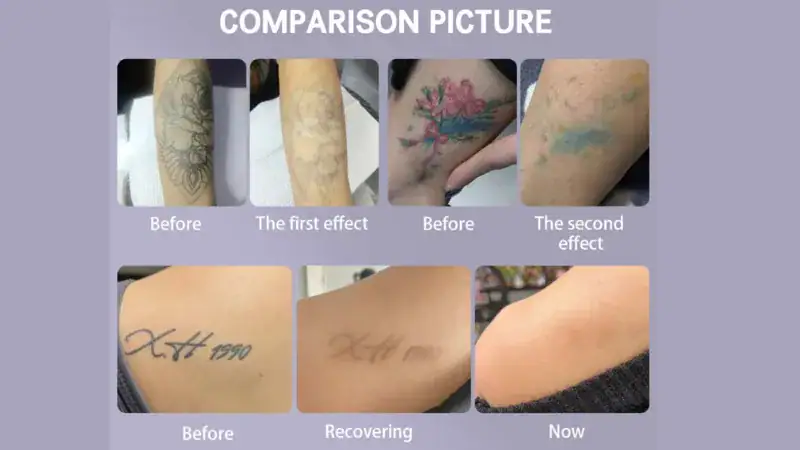
Many buyers make the critical mistake of solely focusing on upfront costs rather than long-term reliability. When evaluating these key factors, you must assess these core specifications to ensure high treatment effectiveness and that you are getting a commercial-grade device:
- Dual Air-Water Cooling System: Professional machines must withstand long hours of continuous use. A robust dual cooling system prevents the laser equipment from overheating and protects the client’s skin from thermal damage during high-frequency operation.
- Stable, High-Pulse Energy: Sufficient energy is required to reach deep dermal pigment and effectively shatter the ink. Cheap, low-energy machines merely fade tattoos slightly and lead to frustrating, prolonged multiple sessions and client complaints.
- Adjustable Spot Size: An adjustable spot diameter allows the technician to balance working speed with precision. Larger spots clear wide areas quickly, while smaller spots are necessary for detailed edges, permanent makeup removal, and partial cosmetic pigment repair.
- Global Certifications: Ensure your device is FDA-cleared (or holds complete CE certification depending on your region). This guarantees the machine meets stringent international safety and operational standards required for legal commercial operation.
- Universal Dual Voltage: Look for regular commercial machines that support 110V/220V universal voltage. This fits different country standards, making it easier for global shipment, local use, and resale value.
Maximizing ROI: Leasing vs. Buying and Multi-Functional Value
It is a big financial decision to buy a commercial aesthetic machine. These devices can cost anywhere from a few thousand to tens of thousands of dollars. As a clinic owner, you have two main options: leasing or buying.
- Leasing: This option has lower upfront costs. It also makes it much easier to upgrade to newer technology later on.
- Buying: Purchasing the laser outright requires more money on day one. However, it results in a much lower total cost of ownership over the machine’s lifespan.
No matter how you pay for the machine, you should always look for a multi-functional device. Exploring various laser uses is the best way to maximize your profit. For example, your main business might be laser tattoo removal services. But with a multi-functional machine, you can also offer permanent makeup removal, acne scar fading, and skin brightening.
Adding these extra services is highly profitable. It dramatically increases your average client spend and helps your clinic stand out in a competitive market.
Summary of Key Points
- Technology Foundation: Laser tattoo removal relies on selective photothermolysis to safely shatter ink particles into microscopic fragments without damaging surrounding skin tissue.
- Choose Based on Market: Q-Switched lasers are highly stable, affordable workhorses ideal for standard black/red ink and new salons. Picosecond lasers are premium, high-speed investments necessary for stubborn colors (green, purple) and high-end medspas.
- Wavelengths are Crucial: Ensure your machine features at least 1064nm (for dark ink and dark skin safety) and 532nm (for red/warm ink) capabilities.
- Prioritize Specifications: Look beyond the price tag. Demand robust air-water cooling, adjustable spot sizes, stable high-pulse energy, and proper CE/FDA certifications to ensure safety and long-term reliability.
- Versatility Drives Revenue: Select multi-functional machines that can perform tattoo removal alongside lucrative skin rejuvenation and pigmentation treatments to maximize your clinic’s return on investment.
Looking for trustworthy commercial tattoo removal laser machines for your business?
Frequently Asked Questions (FAQ)
Q1: What is the main difference between a Q-Switched and a Picosecond laser?
A1: The biggest difference is speed and power. Q-Switched (Nanosecond) lasers: Very reliable and affordable. They break ink down into small “pebbles.” Picosecond lasers (like a Picosure or Picoway laser): Ultra-fast premium machines. They crush ink into microscopic “dust,” which the body clears out much faster.
Q2: How many sessions does a client need?
A2: It depends on the laser technology you use: Standard Q-Switched machines usually take 6 to 12 sessions.
Upgraded pico laser machines can often finish the job in just 3 to 5 sessions, offering a much better tattoo removal experience for the client.
Q3: Can these machines remove all ink colors?
A3: Standard dual-wavelength machines are great for black, grey, dark blue, and red inks. However, if your clinic sees a lot of different tattoo colors—like bright green, purple, or light blue—you will need a high-end Picosecond laser equipped with specific wavelengths to achieve optimal clearance.
Q4: Is laser tattoo removal safe for dark skin?
A4: Yes, it is very safe and effective. You just need to use the 1064nm wavelength setting. This specific setting bypasses the skin’s surface melanin to target deep pigment. It protects the surrounding skin and prevents scars on many skin types, especially darker tones.
Q5: Should I buy or lease my tattoo removal machine?
A5: This depends on your budget. Leasing has a low upfront cost and makes it easy to upgrade later. Buying a device outright costs more on day one, but it significantly lowers your total cost of ownership in the long term, maximizing your profits.
Q6: Can I use this machine for other beauty treatments?
A6: Yes! Most modern tattoo removal devices are multi-functional. By simply changing a setting or a handpiece, your technician can offer extra cosmetic services like: Carbon laser facials (Hollywood peeling), Fading sun spots and freckles, Removing permanent makeup (eyebrows/eyeliner).
Q7: Will the machine overheat if my clinic is busy all day?
A7: It won’t overheat if you buy the right one. When purchasing a laser, always check the cooling system. You need a machine with a “dual air-water cooling system.” This keeps the machine cool and stable, allowing you to treat clients back-to-back all day without any downtime.